Journals
-
JALLIS : Journal of Arabic Language and Literature Studies
JALLIS : Journal of Arabic Language and Literature Studies is an academic platform dedicated to the exploration and advancement of research in the fields of Arabic language, literature, and their pedagogy. It aims to provide a scholarly forum for researchers, educators, and practitioners to share insights, theoretical perspectives, and innovative practices that contribute to the development of Arabic studies in a global context.
This journal covers a wide range of topics, including Arabic linguistics, classical and modern Arabic literature, stylistics, translation studies, and the teaching and learning of Arabic as a foreign or second language. By embracing both theoretical and applied research, it seeks to bridge the gap between scholarship and classroom practices, fostering meaningful contributions to Arabic language education and cultural studies.
Published in English, the journal is issued twice a year, in n February and August, under the auspices of Yayasan JAUDAH AKADEMI INDONESIA. While the journal is not yet accredited, it is committed to maintaining rigorous academic standards and peer-reviewed processes, ensuring the quality and relevance of every published article.
-
JALTECH : Journal of Arabic Learning Technology
JALTECH: Journal of Arabic Learning Technology is an international peer-reviewed academic journal that publishes scholarly research on the integration of technology in Arabic language learning and teaching. The journal aims to provide a platform for researchers, educators, and practitioners to share theoretical insights, empirical findings, and innovative practices related to technology-enhanced Arabic language education.
The journal focuses on the intersection between Arabic language pedagogy and educational technology. It welcomes interdisciplinary studies that examine how digital technologies can support the teaching, learning, and assessment of Arabic as a foreign or second language in various educational contexts.
The scope of the journal includes, but is not limited to, computer-assisted Arabic language learning (CALL), digital learning media, e-learning and online learning for Arabic, mobile-assisted language learning (MALL), artificial intelligence in language learning, corpus-based language learning, learning management systems in Arabic education, digital assessment tools, and innovative technological approaches to Arabic language instruction.
Published in English, the journal is issued twice a year, in June and December, under the auspices of Yayasan JAUDAH AKADEMI INDONESIA. All submitted manuscripts undergo a rigorous peer-review process to ensure academic quality, originality, and relevance. Through this commitment, the journal seeks to contribute to the global development of Arabic language education and to promote the effective integration of technology in language learning.
-
JAUDAH: Journal of Arabic Language Education Transformation
JAUDAH: Journal of Arabic Language Education Transformation is a peer-reviewed academic journal that publishes scholarly works on innovation, development, and transformation in Arabic language education. The journal aims to provide a scientific platform for researchers, educators, and practitioners to share theoretical perspectives, empirical research, and best practices related to the teaching and learning of Arabic in diverse educational contexts. The journal focuses on the transformation of Arabic language education in response to contemporary educational, technological, and socio-cultural developments. It encourages interdisciplinary studies that explore new approaches, pedagogical innovations, curriculum development, and the integration of digital technologies to enhance the effectiveness of Arabic language learning for both native and non-native learners.
The scope of the journal includes, but is not limited to: Arabic language pedagogy and teaching methodologies, Curriculum and instructional design in Arabic language education, Transformation and innovation in Arabic language learning, Educational technology in Arabic language teaching, Digital learning media and online learning for Arabic, Mobile-assisted language learning (MALL) and computer-assisted language learning (CALL) for Arabic, Artificial intelligence and emerging technologies in Arabic education, Assessment and evaluation in Arabic language learning, Arabic linguistics for language teaching, Arabic language learning for non-native speakers (Arabic as a foreign/second language), Sociolinguistic and cultural dimensions of Arabic language education, Teacher professional development in Arabic language education, Community engagement and educational transformation in Arabic language learning.
Published in Bahasa Indonesia or English, the journal is issued twice a year, in june and December, under the auspices of CV. Jaudah Academy. All submitted manuscripts undergo a rigorous peer-review process to ensure academic quality, originality, and relevance. Through this commitment, the journal seeks to contribute to the advancement and transformation of Arabic language education in both local and global contexts.
-
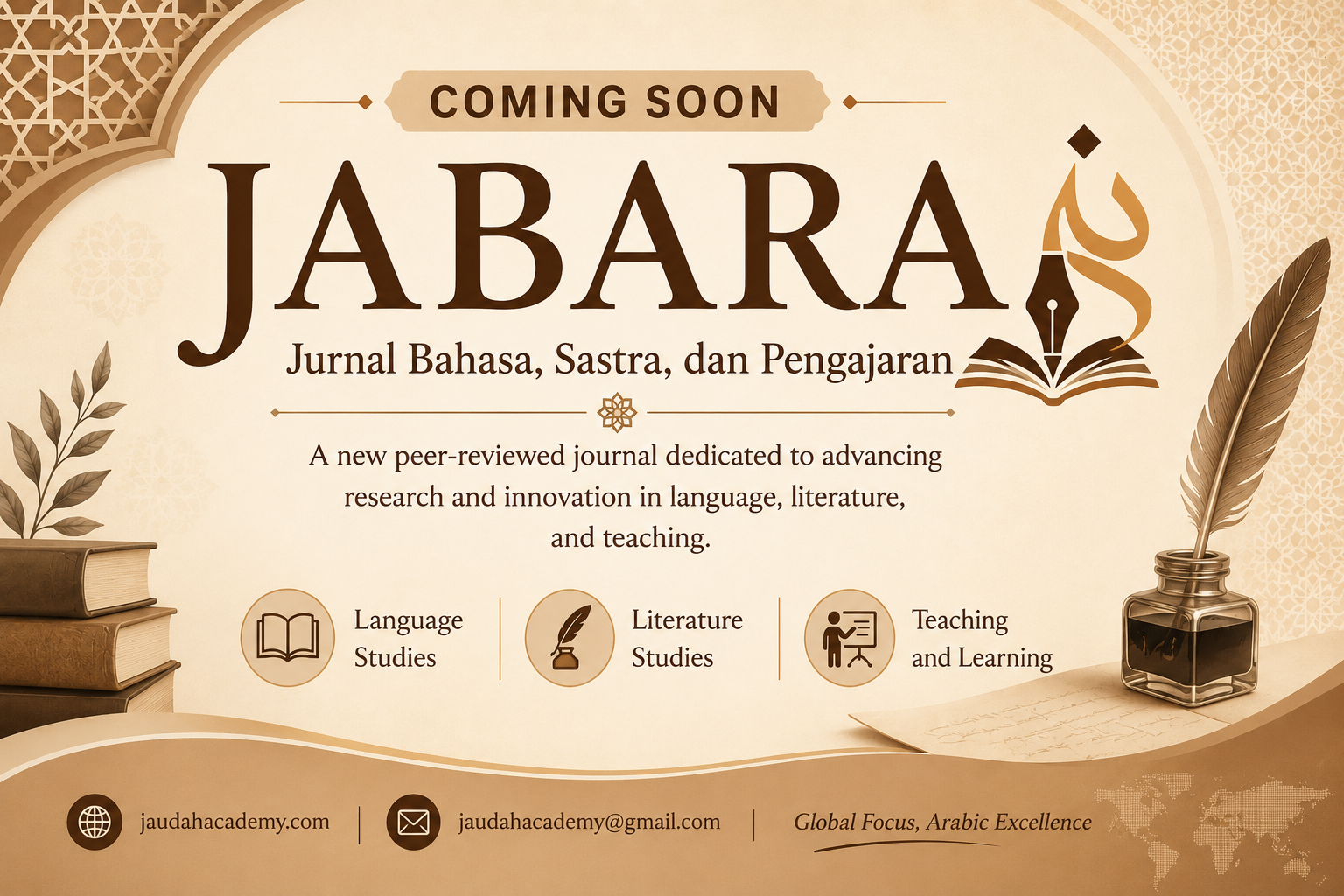
JABARA: Jurnal Bahasa, Sastra, dan Pengajaran
JABARA: Jurnal Bahasa, Sastra, dan Pengajaran
-

Al-Fann: Journal of Islamic Art, Design and Culture
<div style="text-align: justify;">
<p><strong>AL-Fann: Journal of Islamic Art, Design and Culture</strong> is a scholarly journal focusing on the study of art, design, and culture from the perspective of <strong>Islamic Studies</strong>. The journal provides an academic platform for bringing together art, design, education, culture, and Islamic thought in relation to contemporary societal issues and the <strong>Sustainable Development Goals (SDGs)</strong>. AL-FANN views art and design not merely as forms of aesthetic expression and creativity, but also as important components in promoting quality education, strengthening cultural identity and diversity, fostering inclusivity, developing creativity and innovation, and supporting sustainable communities and environments.</p>
<p>From an Islamic perspective, art and design are understood as integral aspects of human life that possess aesthetic, educational, social, cultural, and spiritual dimensions. Islamic values such as justice, balance, public benefit, responsibility, appreciation of diversity, and environmental preservation provide a foundation for developing studies of art and design that are relevant to the challenges of modern life. Through studies in <strong>Islamic Art and Visual Arts, Islamic Design, Islamic Aesthetics and Visual Culture, Art Education and Islamic Education, Islamic Art, Culture and Heritage, and Contemporary Art, Design and Muslim Society</strong>, AL-FANN encourages research that explores the relationships between art, design, culture, education, Muslim societies, and sustainable development.</p>
<p>The journal's commitment to the <strong>Sustainable Development Goals (SDGs)</strong> is realized through the development of knowledge that supports quality education, equality and inclusivity, creativity and the creative economy, cultural heritage preservation, sustainable community development, and responsible artistic and design practices toward society and the environment. In this context, AL-FANN provides opportunities for research that contributes to the achievement of <strong>SDG 4 (Quality Education), SDG 5 (Gender Equality), SDG 8 (Decent Work and Economic Growth), SDG 10 (Reduced Inequalities), SDG 11 (Sustainable Cities and Communities), and SDG 12 (Responsible Consumption and Production)</strong>.</p>
<p>By integrating the perspectives of <strong>Islamic Studies, art, design, culture, education, and sustainable development</strong>, AL-FANN seeks to broaden academic discourse on the role of art and design in Muslim societies and their contribution to building communities that are inclusive, creative, just, culturally grounded, and sustainable. The journal welcomes contributions from academics, researchers, educators, artists, designers, creative practitioners, and students from diverse disciplines to develop knowledge that connects <strong>Islam, art, design, culture, education, and sustainable development</strong> in local, national, and global contexts.</p>
</div>