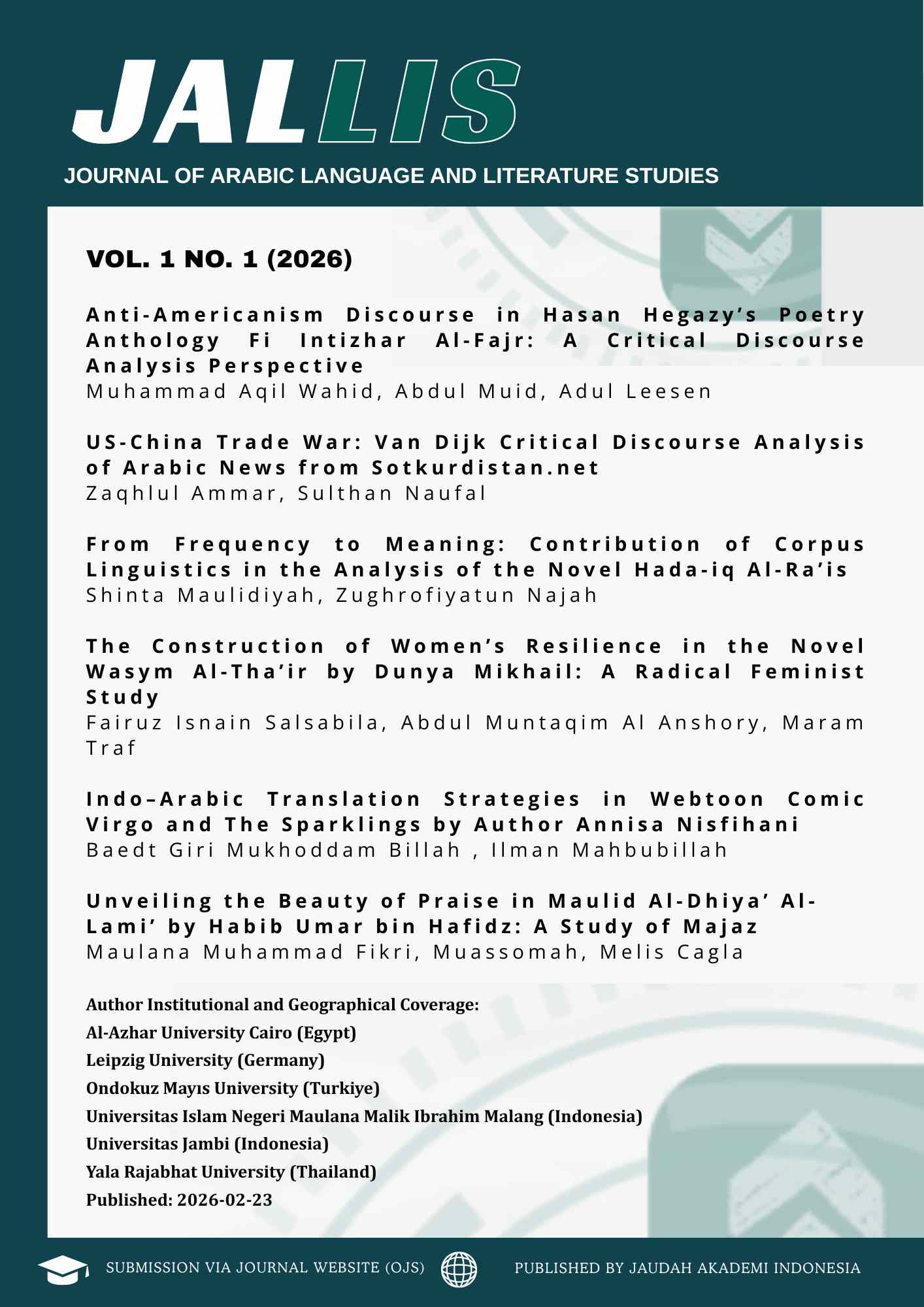
From Frequency to Meaning: Contribution of Corpus Linguistics in the Analysis of the Novel Hada-iq Al-Ra’is
Keywords:
Arabic Novels, Corpus Linguistics, Word FrequencyAbstract
This study analyzes word frequency patterns in Muhsin Al-Ramli's novel Hada-iq Al-Ra’is using a corpus linguistics approach to uncover the relationship between language use and themes of political violence, trauma, and social oppression. This study aims to identify the dominant lexicon and interpret its narrative and thematic functions in the literary text. The method used is a mixed method by combining corpus-based quantitative analysis and qualitative interpretation. The novel text was digitized, cleaned, and analyzed using Voyant Tools to produce word frequency lists, trend visualizations, and lexical maps. The results show that character names, place references, and vocabulary related to power, violence, and everyday life appear dominantly. These lexical patterns reflect the strong narrative of victimhood, awareness as a witness, and collective suffering in the story structure. The dominance of certain vocabulary emphasizes how political repression permeates both public and private spaces, shaping the psychological and social realities of the characters. These findings demonstrate that corpus linguistics-based word frequency analysis is effective in uncovering ideological meanings and social criticism in contemporary Arabic literature.
Downloads
Published
Issue
Section
License
Copyright (c) 2026 Shinta Maulidiyah, Zughrofiyatun Najah

This work is licensed under a Creative Commons Attribution-ShareAlike 4.0 International License.