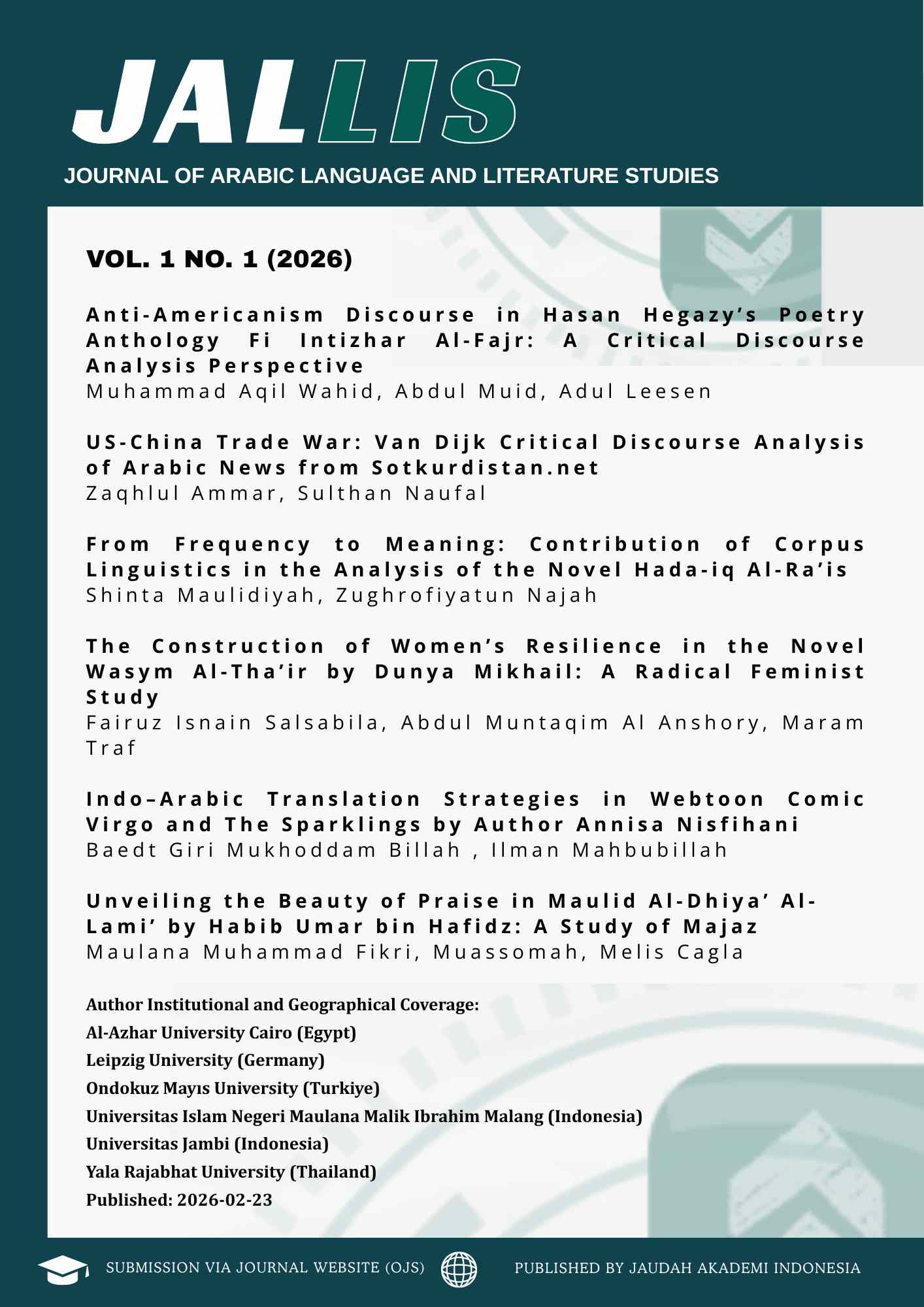
Unveiling the Beauty of Praise in Maulid Al-Dhiya’ Al-Lami’ by Habib Umar bin Hafidz: A Study of Majaz
Keywords:
Arabic stylistics, devotional literature, figurative language, majaz, Maulid Al-Dhiya’ Al-Lami’Abstract
This study examines the use of majaz (figurative language) in Maulid Al-Dhiya’ Al-Lami’, a devotional literary work containing praises for the Prophet Muhammad. The research aims to identify the types of majaz and analyze their symbolic meanings within the text by employing a descriptive qualitative approach. Data were collected through documentation and library research and analyzed using the Miles and Huberman framework, which includes data reduction, data display, and conclusion drawing. The findings reveal five primary instances of majaz, consisting of four examples of isti'arah tashrikhiyyah and one example of majaz aqli with a causal relationship. The dominance of isti'arah tashrikhiyyah indicates a deliberate stylistic strategy, particularly through the consistent use of light metaphors to represent the Prophet as a source of guidance and divine illumination. These metaphors function not only as aesthetic devices but also as symbolic mechanisms that construct theological meaning, strengthen the sacralization of the Prophet’s figure, and foster emotional engagement through religious imagination. Meanwhile, the use of majaz aqli in supplicatory discourse highlights theological relationality and demonstrates the functional alignment between figurative language and communicative intent. Overall, the study concludes that majaz in Maulid Al-Dhiya’ Al-Lami’ operates on three interconnected levels: as an artistic feature enhancing textual beauty, as a symbolic system shaping theological understanding, and as a transformative medium supporting the internalization of spiritual values. These findings contribute to classical Arabic stylistics by showing that figurative language in devotional texts serves as an effective communicative strategy for reinforcing religious messages and cultivating moral orientation.
Downloads
Published
Issue
Section
License
Copyright (c) 2026 Maulana Muhammad Fikri, Muassomah, Melis Cagla

This work is licensed under a Creative Commons Attribution-ShareAlike 4.0 International License.